Great-Great Grandmother
1. Ada Lucy Rockwell
+ Charles E Hotchkiss
2. Ida E Hotchkiss
+ Joseph Willard Munson
3. George Willard Munson
+ Ruth E Koerner
4. Edward (Ned) Deck Munson
+ Debra Florence Dahlquist
5. Scott Edward Munson
Several things about my Great Great-Grandmother, Ada Hotchkiss, intrigued me from the very beginning. First, census records indicated that she had been born in Iowa about 1850. Since all of my other ancestors had been born in New England, New York or Europe, this was the first indication of an ancestor who had moved west, then for some reason, moved back east. Second, the census records further indicated that Ada had been a widow before marrying my Great Great-Grandfather, Charles Hotchkiss. Third, she was thirty years old, living with her uncle in 1880 and Charles was twenty years old working and living on her uncle's farm. They were married shortly there-after.
Ada and Charles are buried together at the Center Cemetery in Norfolk, CT with the following stone marking the spot:

Ada L. R. Curtiss.
I had the hardest time figuring out what her actual maiden name was. Finally, after months of on-line researching, a trip to Norfolk and countless hours in the library, I have discovered a great deal about Ada and her family.
Ada Lucy Rockwell was born February 1850 in Jones County Iowa, the first child of C.C. and Margaret (Phelps) Rockwell. Her parents had moved to Iowa from Norfolk, Connecticut as part of the western migration accross our great country. Remember that at this time, Iowa was very much frontier territory and life must have been very difficult. Think little house on the prairie only a few years earlier. Her father, C.C. (Christopher Columbus) Rockwell, was the first attorney in Jones County Iowa, and was instrumental in the formation of government and laws there. He served in the Iowa Senate for several years as a relatively young man.

This is a picture of Main Street Anamasa, IA
in 1891. CC Rockwell served as Postmaster here
some 40 years earlier.
In 1854, C.C and Margaret had their second daughter, Georgianna. Shortly after, Ada experienced the first of a series of tragedies which would occur before the age of twenty-five. Her mother, Margaret, passed away in Keokuk, Iowa. It is unclear, at this point, exactly what happened to the family. With no other family in Iowa, it is very probable that they moved back east and the girls were raised by relatives in Norfolk. There are several records of C.C. Rockwell practicing Law in New York City during the 1860s but nothing which shows the girls were living there. He had spent part of his childhood there where his father worked as a merchant businessman. When Ada was only 17, her father died in New York City, leaving her and her sister as orphans.
I have been unable to find any record of Ada or C.C. in the 1860 Census. It is likely that Georgianna was living in Waterbury, CT with C.C.'s brother, Philo Guiteau Rockwell, a sergeon, and his family. By 1870, C.C. had died and Philo had moved to South Carolina, so Georgianna was living in Norfolk, CT with her mother's brother, Levi Phelps, and his family. There is a record of an Adele L Rockwell living with the Thompson family in Waterbury, CT in 1870 as a teacher. The age is correct and the name is close but the birthplace is listed as New York. Still, it is very possible that this is our Ada since her uncle had lived in Waterbury and her father was from New York. I believe this was Ada Rockwell.

This is a one room schoolhouse in Norfolk, CT. It is possible that
Ada taught in a school like this or even in this very one!
There were several at the time in Norfolk.
In 1872, Ada married Henry Curtiss, a farmer from Norfolk, CT. They had been married only a year when tragedy struck once again. Henry was killed in an accidedent at the age of 23 making Ada a widow seven months pregnant. She had lost her mother, her father, and now her husband, all before the age of twenty-five. Fortunately, Ada was living in Norfolk and would have had the support of both hers and her husband's family and friends to get through this very difficult time. By 1880, Ada was working again as a teacher. She and her six year old daughter were living with Henry's uncle, Philip Curtiss, and his family on their farm in Norfolk. At the same time Charles Hotchkiss was working and living on the Curtiss farm. It is impossible to know now how this romance came to be, Ada the widow school teacher and Charles the much younger Farm Laborer, but with-in a year they are married.
Church of Christ on the Norfolk Green
Ada and Charles raised six children together in Norfolk, including Mary Curtiss, the daughter of Henry Curtiss and Ida Hotchkiss, my great-grandmother. One daughter, Jennie, died shortly after birth and is listed on the back of Charles and Ida's tomb stone.
In the 1900 Census, Charles is listed as a gardner, supporting the family with Ada at his side. Listed in the household is Mammie age 26 (this is either a transcription error or nickname for Mary Curtiss) Anna age 18, Mertie age 15, Ida age 14, Wallace age 10 and Edith age 9. A family of daughters with Wallace the only son.
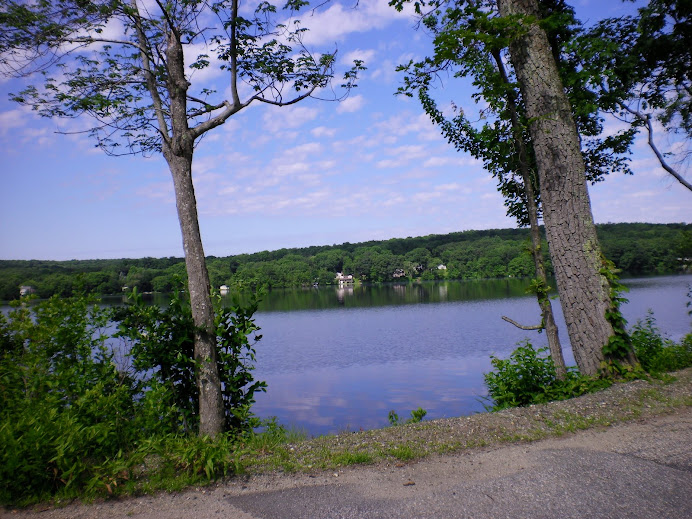
This is the neighborhood where Charles grew up. It is
likely that he and Ada lived close by.
By 1910, Anna, Mertie and Ida had all moved out, leaving Ada and Charles with Mary Curtiss, Wallace and Edith at home. Also living with them is Charles' uncle, Horatio Smith. Shortly after the the 1910 Census was taken, Ada passed away at the age of 60. She did not live long enough to see her daugher Ida get married or to meet her grandson, George Willard Munson, my grandfather.
Charles lived another 34 years but never remarried.