Andover, Connecticut
Showing posts with label Munson. Show all posts

Thursday, July 4, 2013

Colonel Jonathan Pettibone

1. Jonathan Pettibone
+Martha Humphrey
2. Giles Pettibone
+Margaret Holcomb
3. Lucy Pettibone
+Augustus Phelps
4. Margaret Phelps
+C. Columbus Rockwell
5. Ada Lucy Rockwell
+Charles E. Hotchkiss
6. Ida Elizabeth Hotchkiss
+Joseph Willard Munson
7. George Willard Munson
+Ruth Marie Koerner
8. Edward Deck Munson
+Debra Florence Dahlquist
9. Scott Edward Munson

My Sixth Great-grandfather's hat is in the Smithsonian Institute! In honor of Independence Day, here is a little about one of our ancestors who served in the War for Independence and gave the ultimate sacrifice for our freedoms.

Colonel Jonathan Pettibone's tricorn hat

Jonathan Pettibone was born in Simsbury, Connecticut in 1709 to Samuel and Judith (Shepherd) Pettibone. He was one of nine children growing up in a prominent Simsbury home.

He married Martha Humphrey, the daughter of Thomas and Hannah (Hillyer) Humphrey.  They raised seven children including my Fifth Great-grandfather, Giles Pettibone, on their large Simsbury farm. He was a prominent citizen of Simsbury, serving as one of the town leaders and representing the town in the Connecticut General Assembly.

In 1775 he heeded the call from Boston and fought for the Colonists in the Battle of Bunker Hill. The next year he was killed in a military skirmish in Rye, New York on September 26, 1776.
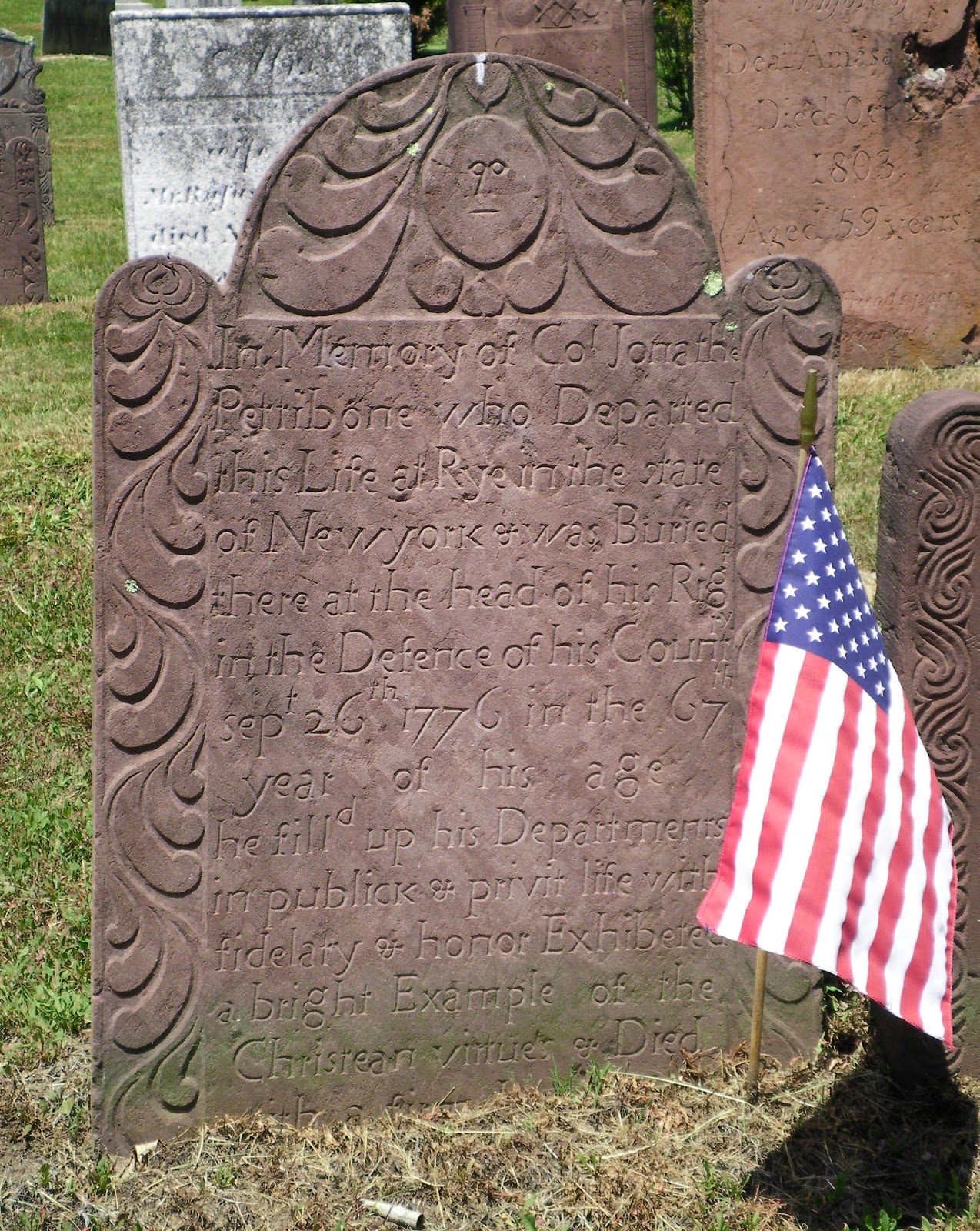
Grave Stone in Simsbury, CT

Here is a link to his Wikitree page which has more detail on his civic and military service.

The tricorn hat which he wore in battle is part of the collection at the National Museum of American History in Washington DC. Here is a link to it on the Smithsonian Institute webpage.

Martha Humphrey Pettibone outlived her husband by 20 years and eleven days. She died a Revolutionary War Widow on October 7, 1796 at the age of 85.

Martha's grave stone in Simsbury, CT

Sunday, January 1, 2012

George W. Munson

Great Great-Grandfather

1. George W. Munson (1859-1943)
+ Eleanor A. Parsons (1853-1923)
2. Joseph Willard Munson (1885-1961)
+ Ida E. Hotchkiss (1885-1861)
3. George Willard Munson (1915-1993)
+ Ruth Marie Koerner (1917-2003)
5. Edward (Ned) Deck Munson
+ Debra Florence Dahlquist
6. Scott Edward Munson


This is a picture of George W. Munson, the grandfather of my Grampa, George Willard Munson, sitting in a rocking chair.  On his lap is my aunt, Barbara (Munson) Herrick, his great-grandchild.


George W. Munson was born on November 10, 1859 to John and Mary J (Warner) Munson in Sheffield, Massachusetts, a town which borders Litchfield County Connecticut. His birth is registered in the town record of Sheffield as George Munson - no middle name. His father, John, was a farmer in Sheffield and George grew up there with his parents and three sisters: Julia, Nellie and Minnie. 


1939 Print from Sheffield, MA

In the 1880 Census, George was living with his parents and sister, Nellie, in Sheffield,  He was a young man of twenty and working as a farm laborer, probably on his father's farm.

Sometime before 1885, George moved to Norfolk, Connecticut and was married to Eleanor A. Parsons, the daughter of a shoemaker in Norfolk.  Their first child, Joseph Willard, my great-grandfather, was born on May 13, 1885 in Norfolk.  They later had a son, Frank Warner, who died shortly after birth.  Ruth Warner, Aunt Ruth as she was known to my grandfather and father, was born a year later in 1892. 

In the 1900 Census, George and Eleanor and their two children were still living in Norfolk.  George's occupation was listed as Teamster.  This occupation was listed again in the 1910 Census. Since the Internation Brotherhood of Teamsters union was not founded until 1904, this probably means that he drove a team of horses.  Remember, automobiles were still very rare at this time so products and people would be transported from town to town by train or wagon.  He would have been the modern truck driver of his day!

Eleanor Passed away in 1923 and some time after that George moved in with is son and daughter-in-law, Joseph and Ida (Hotchkiss).  George was living with them in Winsted, CT during the 1930 Census.  The household included a 14 year old George Willard Munson and his younger sisters, Ada and Eleanor. 

George W Munson died in 1943 and is buried at the Center Cemetery with his wife Eleanor and all of his children. George, Eleanor, Frank and Ruth's names are all listed on one side of the stone.  Joseph and Ida's names are on the other side.


Now, you may have noticed that I have only identified George's middle initial throughout this post.  We know that Joseph was named Joseph Willard and my grandfather was George Willard but I have not found a record of Joseph's father's middle name - only the initial W.  I suspect that it is NOT Willard.  I believe the name Willard came from Eleanor's side of the family and will explain this further in a future post.  My best guess for George W's middle name is that it was Warner - his mothers maiden name.  This is reinforced by the fact that he gave both a son and a daughter that for a middle name. Two other possibilities are William or Wells since his mother's father was William Wells Warner.  If you know the answer to this mystery, please comment otherwise I will continue to search for the answer.

Tuesday, August 10, 2010

Capt. Thomas Munson part 2

This is a follow-up to my Captain Thomas Munson post. I was in Hartford last week visiting the Center Church which was founded by my Tenth Great-Grandfather Thomas Hooker in 1636. In the ancient burial grounds which are located next to the church is the monument which has been erected in honor the the founders of Hartford. It turns out that Thomas Munson is listed on the monument as one of the 163 men who owned land in Hartford before February 1640.


This monument was erected in 1986 and is made of pink Connecticut Granite. It replaced a brownstone monument which had been erected in 1837. The new monument contains several names which were not on the original monument, including that of Thomas Munson.

Tuesday, August 3, 2010

Captain Thomas Munson

Tenth Great-Grandfather
Immigrant Ancestor

1. Captain Thomas Munson

+ Joanna (Mew?)
2. Samuel Munson
+ Martha Bradley
3. Samuel Munson
+ Martha Farnes
4. William Munson
+ Rebecca Curtis
5. William Munson
+ Sarah Griggs
6. David Munson
+ Mary Ann Ballard
7. Stephen Munson
+ Nancy Nash
8. John Nash Munson
+ Mary Jane Warner
9. George W. Munson
+ Eleanor A. Parsons
10. Joseph Willard Munson
+ Ida E. Hotchkiss
11. George Willard Munson
+ Ruth E. Koerner
12. Edward (Ned) Deck Munson
+ Debra Florence Dahlquist
13. Scott Edward Munson


The First Munson to arrive in the New World was Thomas Munson who first appears in Hartford, CT as a militia member in the Pequot Wars of 1637. He was born in 1612 in Rattlesden, Suffolk, England, the seventh child of John and Elizabeth (Sparke) Munson. He is the ancestor of all Munsons who live in America today.

The Munson Crest

"Truth Conquers All"

His arrival is not recorded but was probably a few years before 1637. He may have lived in Newtowne (Cambridge) for a while with the other settlers of Hartford, but there is no record of him there or as an original founder of Hartford in 1636. He was a carpenter, and he probably built a house in Hartford on the land he received in recognition for his service in the Pequot Wars. His two-and-a-half acres were on the spot where today I-84 crosses High Street. So, remember that the next time you pass through Hartford on I-84!

He sold this land in 1639 and moved to Quinnipiac (New Haven). Why he did this after such a short stay in Hartford is unknown. It could be that he met soldiers from New Haven who spoke of its beauty and promise or it could be that his skills as a carpenter were more valuable in the wealthier New Haven Colony. Either way, he is one of only two people who left the Hartford Colony to settle in New Haven. He arrived not long after the Fundamental Agreement of the New Haven Colony was established. His is the sixth signature to be added to the Fundamental Agreement after the original sixty-three men established it as law.


The first meetinghouse in New Haven of which Thomas Munson was continually called upon to evaluate for repairs.

Thomas Munson was a man of importance in the new Colony. His judgement was called upon by the general court for a variety of committees in his early life in New Haven. He served as one of four Lieutenants in the town, maintaining and training the militia for watches and protection as necessary.

In 1655, Thomas Munson was one of the leaders of a group within New Haven who wished to start a new settlement on the Delaware Bay. New Haven was becoming crowded and many felt it was necessary to start fresh somewhere else. For a variety of reasons, this new settlement never happened. Imagine how history would be changed if half the people who lived in New Haven at the time, had migrated to the Delaware Bay. There was even some discussion that the group would move to Jamaica! Instead, Thomas Munson Purchased property in the center of town which he would own until his death and which would be passed down for several generations. That property is is traversed today by Temple Street and is located between Walnut and Grove Street. It is part of Yale University.

Thomas Munson continued to live in and serve the town of New Haven for the remainder of his life. In 1656 he was chosen one of seven town selectmen. In 1662 he was chosen to be a Deputy for the town court. In 1663 he served as a deputy on the General Court as a substitute for Lieutenant Nash. He served in these posts off and on throughout his life. He was a member of the General Court in New Haven when it became a part of the Connecticut Colony in 1664 and served as one of the first deputies from New Haven in the General Assembly in Hartford. He also served as foreman of the jury for the first jury trial to take place in New Haven.

In addition to his service in the government offices of the New Haven and Connecticut, Thomas Munson served the in the militia throughout his life. Known early as Lieutenant Munson, then as Ensign Munson and later as Captain Munson. He was continually involved in the watch and protection of New Haven, including leading battalions in King Phillips War, a major Native American uprising which took place in New England during the mid 1670s. He held the position of Ensign, reluctantly, for many years - at first turning it down and later requesting to be removed from it. The ensign carried the flag - and I can only imagine that it would be much harder than it sounds. He never felt that he did it well but since nobody else was willing to do it at all, he was stuck with the job!

Thomas Munson was married to Joanna - possibly Joanna Mew. They were married before 1642 when their first child Elizabeth, was born. In 1643, their only son and my ninth great-grandfather, Samuel was born. Their youngest child, Hannah, was born in 1648. Elizabeth married Timothy Cooper and later Richard Higenbothom. Samuel married Martha Bradley in New Haven before settling in Wallingford. Hannah married Joseph Tuttle.

This is the memorial for Thomas and Joanna Munson in the Grove Street Cemetery. The original stone for Thomas is set in the new memorial.


Joanna died in 1678 and Thomas Died in 1685. They were both buried on the New Haven Green. Their tombstones were later moved to the Grove Street Cemetery where the above memorial was erected.


Thomas Munson was one of the great early leaders of New Haven and you can read more about his accomplishments, ancestry and descendants in the book: The Munson Record.


You can also find out more on the website of the Thomas Munson Foundation.

Monday, July 19, 2010

Update

I updated the Scott Munson's Family Tree page on this blog to include the next generation, my third great-grandparents. In case your not sure how this works, if you double a person's number, it is the number of that person's father. If you double a person's number and add 1, it is the number of that person's mother. If numbers are missing, then I don't know who those parents are yet. For instance, Ida Hotchkiss is #9. Her father, Charles Hotchkiss, is #18 and her mother, Ada Rockwell is #19. Mary Zantop is #23 but there no #46 or #47 because I haven't figured out who her parents are yet. As I add more and more generations, there will be more and more missing numbers.

Monday, June 28, 2010

William the Conqueror, King of England

Ok. It's been a while since I posted, and I promised you royalty, so this is as good a time as any to end the suspense. This ancestry line is actually on the Munson side flowing through my Fourth Great Grandmother, Nancy Nash, and our immigrant ancestor, Elizabeth (St. John) Whiting.


William I, King of England was my Twenty-ninth Great-Grandfather. He was born about the year 1027 in Normandy. Because he was the illegitimate son of Robert I, Duke of Normandy, he was called William the Bastard by his detractors. His father died when he was seven, leaving the succession as Duke of Normandy to William in his will. He became King of England on Christmas Day 1066.

I won't recount a full biography of William the Conqueror here. You can google his name to get a wealth of information. He died in 1087.

1. William the Conqueror, King of England
+ Lady Matilda
2. Princess Gundred
+ William, Earl of Warren
3. William, second Earl of Warren and Surrey
+ Lady Isabel de Vermandois
4. Lady Gundred de Warren
+ Roger de Newburgh
5. Waleran de Newburgh
+ Lady Alice, daughter of John d'Harcourt
6. Lady Alice de Newburgh
+ William de Manduit, Baron of Hanslape
7. Lady Isabel de Manduit
+ William, fifth Baron of Beauchamp
8. Walter de Beauchamp, Baron of Alcester & Powyke
+ ???
9. Giles de Beauchamp, Baron of Alcester & Powyke
+ ???
10. Roger de Beauchamp, first Baron Beauchamp
+ ???
11. Roger, second Baron Beauchamp
+ ???
12. Sir John, third Baron Beauchamp
+ ???
13. Lady Margaret de Beauchamp
+ Sir Oliver de St. John
14. Sir John de St. John
+ Lady Alice, daughter of Ser Thomas Bradshaw
15. Sir John de St. John
+ Lady Sybil
16. Sir John de St. John
+ Lady Margaret, daugher of Sir William Walgrave
17. Oliver St. John
+ Agnes Fisher
18. Thomas St. John
+ ???
19. Sir Oliver St. John
+ Sarah Bulkley
20. Elizabeth St. John (immigrant ancestor)
+ Rev. Samuel Whiting (immigrant ancestor)
21. Rev. Joseph Whiting
+ Mary Danforth
22. Samuel Whiting
+ ???
23. Benjamin Whiting
+ Rebecca Parmelee
24. Benjamin Whiting
+ Esther Merriman
25. Esther Whiting
+ Captain John Nash
26. Nancy Nash
+ Stephen Munson
27. John Nash Munson
+ Mary J. Warner
28. George W Munson
+ Eleanor A Parsons
29. Joseph Willard Munson
+ Ida E Hotchkiss
30. Sir George Willard Munson of Winsted, Connecticut
+ Lady Ruth E Koerner of Greenwich, Connecticut
31. Lord Edward Deck Munson of Columbia, Connecticut
+ Lady Debra Florence Dahlquist of Wells, Maine
32. King Scott Edward Munson of Jackson Heights, New York
Just in case my claim to the thrown is questioned, I have discovered a second line of ancestry to King William I which goes through my great-grandmother, Ida Hotchkiss. I will post this in the future.

Tuesday, June 15, 2010

Thomas Danforth & The Salem Witch Trials

Immigrant
Tenth Great-Grandfather

1. Thomas Danforth
+ Mary Withington
2. Sarah Danforth
+ Rev. Joseph Whiting
3. Samuel Whiting
+ unknown wife
4. Benjamin Whiting
+ Rebecca Parmelee
5. Benjamin Whiting
+ Esther Merriman
6. Esther Whiting
+ Captain John Nash
7. Nancy Nash
+ Stephen Munson
8. John Nash Munson
+ Mary J Warner
9. George Willard Munson
+ Eleanor A Parsons
10. Joseph Willard Munson
+ Ida E Hotchkiss
11. George Willard Munson
+ Ruth Koerner
12. Edward (Ned) Deck Munson
+ Debra Florence Dahlquist
13. Scott Edward Munson

Thomas Danforth was born in Framingham, Suffolk, England in November 1622. He was the fourth child of Nicholas and Elizabeth (Symmes) Danforth, members of a wealthy family who sympathized with the separatist puritans. His mother died when he was only seven, and his father decided to sell his estate and head to the New World when King Charles I decided to impose a heavy annual tax on wealthy people for a title which Nicholas did not want.

Nicholas and his six children, including Thomas, joined his brother-in-law, Zechariah Symmes, on board the ship Griffin which arrived in Massachusetts in 1634. In the first of two connections to Thomas Hooker, this is the same ship which carried Rev. Hooker across the Atlantic a year before. The second connection takes place in 1636 when Nicholas purchases land from Thomas Hooker in Cambridge when Hooker leaves for Hartford, Connecticut. Nicholas died in April of 1638 in Cambridge, Massachusetts where the family had settled.

As the oldest son, Thomas would have inherited a considerable portion of his father's wealth. He may have helped raising his younger siblings and was admitted to the Dorchester church in 1741 at the age of 19 - a big deal at the time. On February 23, 1643/4 he married Mary Withington, the daughter of Henry Wilthington who was the first ruling elder of that church. Together Thomas and Mary had twelve children, but only three daughters survived him, including my Ninth Great-Grandmother Sarah who married Rev. Joseph Whiting. Six of the Danforth's children died before the age of two.

In 1645, at the age of 26, he was appointed selectman and Town Clerk of Cambridge, Massachusetts.

Actor Paul Scofield played Judge Thomas Danforth in
the movie version of the Crucible. Not a guy you'd want
to see on the bench when you show up for court!

Even though Thomas never attended college, he was appointed treasurer of Harvard college in 1650, a position he would hold for nineteen years. After that, he served another 13 years as it's steward. His father had given considerable funds to start the college and his younger brother, Samuel, was a member of the second class to graduate from Harvard in 1643. Josiah Quincy, one of the first Presidents of Harvard, called Thomas Danforth "the earliest, most steadfast and faithful of it's friends."

He was elected Cambridge's representative to the General Court in 1657 and was appointed deputy Governor under Governor Simon Bradstreet in 1679. He may have been elected Governor if the very popular Bradstreet had not lived so long.

During King Philip's War, a Native American uprising in New England which lasted several years starting in 1675, Thomas Danforth was particularly concerned for those Native Americans who had converted to Christianity. They were called "praying Indians" and they remained loyal to the English. He did not want to see them get caught up in the fury of war just because they looked like the enemy. He continued to speak out for them even after being threatened by those who disagreed with him for defending them.

In 1677, Massachusetts purchased the province of Maine and decided to set up a provincial government. Thomas Danforth, while serving deputy-governor of Massachusetts, was appointed the first President of the District of Maine. He traveled to Casco Bay in the summer of 1680 and began the first government there. He spent most of his time in Cambridge but traveled to Maine as necessary, allowing a deputy-president to serve in his absence. By all accounts he was a wise, judicious and kind leader who brought a sense of law and order to the wilds of colonial Maine. Part of his legacy was to lay out Fore Street, Middle Street and Congress Street in Portland, Maine.

Congress Street in Portland, Maine today. I used to live
a block from where this picture was taken!

In 1686, the new King, James II, appointed Sir Edmund Andros to serve as his Royal Governor over all of New England, ending Thomas Danforth's offices and severely limiting government by the people. Many spoke out against this, at their own peril, including Thomas Danforth who wrote: if our ability to rule ourselves is "dissolved by his Majesty, against this people's will and without their fault, what other bond remain to oblige them to him as subjects!" These were treasonous words for that time, and it is probably fortunate for him that the king was across the ocean and that his reign only lasted until 1688.

When word reached New England that William and Mary had replaced James II on the throne of England in the Glorious Revolution, Andros was arrested and Thomas Danforth was returned to his positions as deputy-governor of Massachusetts and President of Maine.

One of the duty's of the deputy-governor was to serve on the Superiour Court. It was in that capacity that Thomas Danforth became entangled in the Salem Witch Trials, which were brought before it in 1692. In Arthur Miller's play and movie "The Crucible" which fictionalize the events of these trials, Thomas Danforth is portrayed as a pompous bureaucrat who oversees the proceedings and allows the letter of the law to over-rule common sense. It's a GREAT movie and I highly recommend seeing it, but don't take away this portrayal of our ancestor as absolute fact. I recommend the following website after seeing the movie:
http://www.17thc.us/docs/fact-fiction.shtml


The truth is that Thomas Danforth only served as a judge on occasion but worked behind the scenes to see the trials come to an end. Samuel Sewell, who was the only judge to publicly express regret over the proceedings, said that Thomas Danforth "did much to end the troubles under which the country groaned in 1692." It was Governor Phipps who finally put and end to the insanity, possibly under the counsel of Thomas Danforth and others.


On March 26, 1697, his wife, Mary, died. He died on November 5, 1699 at the age of 77. His burial is unknown. Since all his sons had proceeded him in death, he left the bulk of his considerable estate to his son-in-law Joseph Whiting, the pastor of the church at South Hampton on Long Island and my Ninth Great-Grandfather.

I wish I knew what ever happened to it!

Thursday, June 3, 2010

Introduction

OK. So, back in November of 2009, I decided to sign up for a free two week trial at ancestry.com. My great-grandmother on my Mother's side was Jennie Hooker, a direct descendant of Thomas Hooker, the "founder" of Hartford and Thomas Willett, the first English mayor of New York City, but that was all I knew. My uncle, Jim Buggie, had been doing some research on that side of the family, so I was especially interested in researching the Munson side. As far as I knew, nobody that I knew had ever taken on that task. What I discovered in those two weeks has opened my eyes to a whole new world of investigation and discovery and has kept me an addicted subscriber to ancestry.com.

I decided that I wanted to share some of what I was discovering with family members around the country, and hopefully tap into some of their collective memory and wisdom. At first I was thinking of publishing some sort of newsletter which I could mail or email to family quarterly. How old fashioned! I had been throwing that idea around for several months before it occured to me I could much more easily create a blog to post pictures, articles and stories as I discover them. So here we go.

I have been researching both sides of my family tree using an ancestral approach rather than a descendant approach. I have information on all of my Great Grandparent's names: Munson, Hotchkiss, Koerner, Von Deck, Dahlquist, Hooker, Bowman and Crogent. I hope to present profiles of ancestors in such a way that they are more than just a name and dates, but are connected to the events of the world around them. So far I have found immigrants from England, Scotland, Ireland, Germany, Sweden and the Netherlands. There are original puritan settlers of New England, key members of the Salem Witch Trials and other witch trials and a well-known King. Yes, a King!

I will try to indicate how each post is connected to me so that you will be able to figure out how it is connected to you. Hopefully you will enjoy what you read and maybe be sparked to do some research of your own. Be sure to add any comments you want to the post and make any corrections which need to be made.

I dedicate this blog to my Grandparents: Gram, Gramp, Nana and Grampa John (George, Ruth, Florence and John).